Robot Handover Modes: Remote Control and Headless Driver
2026-11-05
Robot Handover Modes: Remote Control and Headless Driver
Remote Control and Headless mode can appear beside each other in a robot handover, but they do not name one setting. Universal Robots documentation uses local and remote for the robot's control context, while its ROS 2 driver separately describes Teach Pendant and Headless modes. A documented requirement connecting them is not a synonym. A clear handover identifies which system owns each mode before discussing the proposed arrangement. This article reads the sources without enabling a mode, connecting a driver or sending a robot command.
Name the owner before interpreting the mode
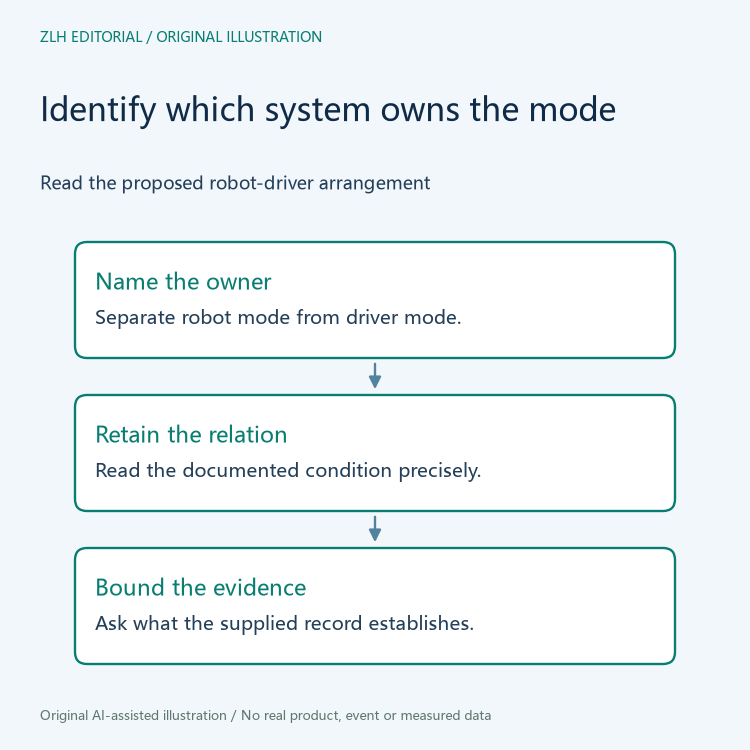
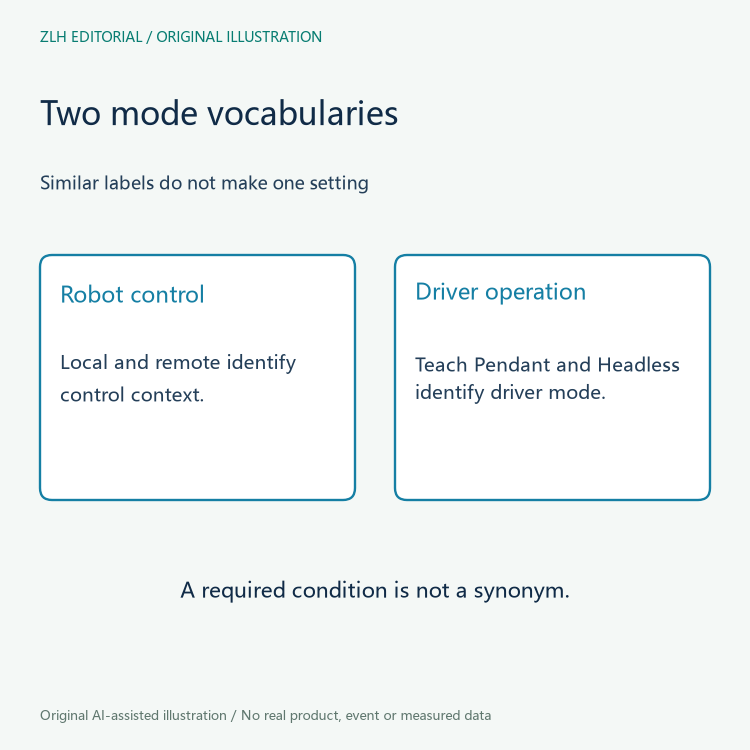
The official UR ROS 2 driver operation-modes document begins by identifying two different mode sets. One belongs to the driver and distinguishes Teach Pendant from Headless operation. The other belongs to the robot and distinguishes local from remote control. The document's structure is useful evidence that a handover should keep two separate explanations, even when a project summary uses the single word mode.
A supplier can therefore be asked which part of a statement describes the driver and which part describes the robot. A screenshot or configuration excerpt should retain its source identity. If the offer merely says remote system, that phrase may leave the driver arrangement unresolved. The recipient should preserve the ambiguity as a question instead of populating the missing setting from a familiar label.
Read local and remote within the robot context
The official PolyScope X SW10_15 Remote Control page distinguishes control through external sources from local control through the teach pendant. It describes restrictions associated with those modes. That is a robot-interface explanation. It does not, by itself, identify every driver or application connected to an unknown system.
The page also states a relationship to Automatic mode in its own PolyScope X context. Keep that qualification with the page rather than combining every use of automatic, remote and headless into a universal vocabulary. This article does not reproduce the page's enabling steps or advise changing an operational setting. Its concern is making a retained technical description understandable.
Read Headless as a driver mode with a stated condition
The driver document explains Headless operation separately from robot control mode and states that e-Series and newer robots require remote control for that driver mode. This is a conditional relationship between two named subjects. Writing remote equals headless would remove the subject distinction. A requirement can be important to understanding an arrangement while still leaving two different mode names.
Consider a fictional handover table with one column labeled mode and the entry remote/headless. The recipient could ask whether the slash indicates two separately documented settings or an assumption that one label explains the other. This invented example contains no real robot, runtime trace or failed connection. It illustrates a documentation ambiguity that can be clarified before anyone makes a claim about the installed system.
Retain the documented combination that defeats a shortcut
The driver document explicitly notes that its Teach Pendant mode can also be used together with the robot's remote control mode. This is why a handover should not infer Headless operation simply from the word remote. Keep the combination as a documented possibility and ask what the actual offer contains. A possible combination is not evidence that it was selected on a particular machine.
The source also identifies its control-mode discussion as inapplicable to the CB3 series and distinguishes PolyScope contexts. Those boundaries should remain visible when a supplier discusses older equipment or a different software family. Neither the manual route nor the driver's current main branch identifies an unknown installation. The actual robot generation and delivered software need their own records.
Describe the handover result at the level reviewed
A useful review can establish that the robot and driver mode descriptions have separate owners, that a required relationship has been explained and that the proposed combination is identified. It cannot establish that commands were accepted, a task ran correctly or the application is suitable merely because the labels now make sense. Those are different questions requiring appropriate implementation and observation evidence.
When a supplier responds, keep the answer attached to the same robot and driver version discussed in the offer. If the response refers to a different configuration, record the difference. A clear unresolved item is more useful than a general statement that the system is configured, because the next reviewer can see which relationship remains to be established.
Both sources were read on November 5, 2026, with their separate manual and repository contexts retained. The illustrations are original conceptual aids, without an interface screenshot or a real operating result. Related reading appears in the intelligent equipment handover collection and article directory. A precise Remote Control note identifies its owner and leaves the driver-mode explanation visible.