
Camera Frame FAQ: Body Axes and Optical Axes in Records
2026-11-05
Camera Frame FAQ: Body Axes and Optical Axes in Records
A Camera Frame entry can look complete while leaving the meaning of its axes unclear. The labels x, y and z are not enough when a record combines a camera's optical convention with a robot body's convention. A reader may interpret the same word “forward” differently in the two contexts. This FAQ uses the official RealSense ROS wrapper documentation and ROS REP103 to explain what an equipment specification should preserve. It does not connect a camera or transform actual measurements.
What does forward mean in the two conventions?
The RealSense ROS2 wrapper README describes the robot convention as x forward, y left and z up. Its optical convention is x right, y down and z forward. The same section gives a viewpoint from behind the camera looking forward. A specification excerpt needs the convention and viewpoint together, rather than copying an isolated arrow label.
Those descriptions do not imply that one convention is a faulty version of the other. They describe different frame conventions used in the documentation. If an equipment worksheet says that forward is x in one row and z in another, the reviewer should first ask which frame each row names. Declaring one row wrong before locating that context would replace a documentation question with an unsupported judgment.
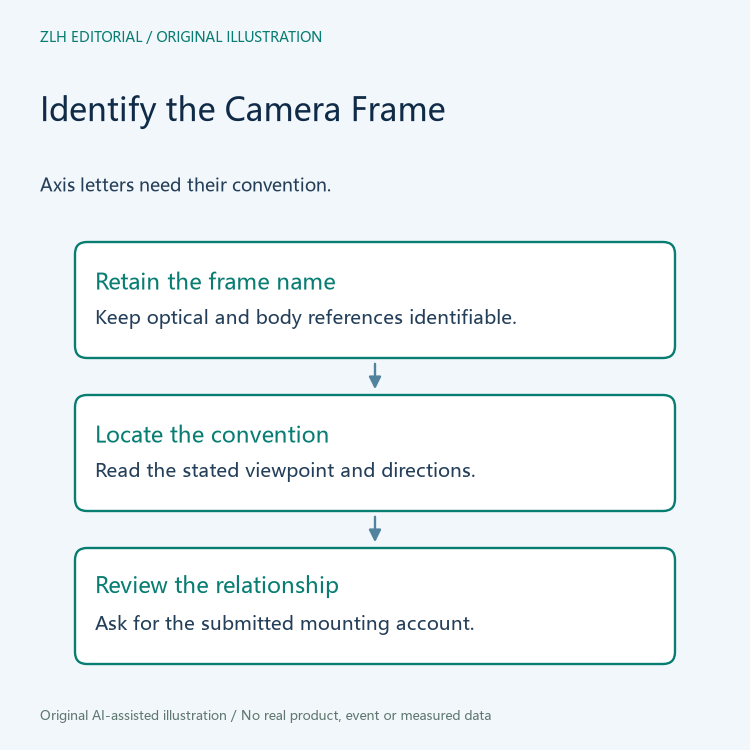
Why retain the optical suffix and the full frame name?
REP103's source text explains the body convention and a camera frame often carrying an optical suffix. It is an informational ROS reference with documented exceptions, rather than evidence that every device or external application must use identical conventions. Use its vocabulary to ask about the actual interface being documented.
A proposed equipment register should retain the submitted full frame name, its stated axis convention and the source of that interpretation. Shortening every frame to “camera” can erase the very distinction the reader needs. It can also hide whether the contributor is describing a body frame, an optical frame or an informal name in an illustration. The register should make that ambiguity answerable without inventing a missing transform.
Is a name enough to establish the camera's mounting relationship?
No. A naming convention and a mounting relationship answer different questions. The RealSense README describes transforms between sensor-related frames and discusses the wrapper's frame organization. That explanation gives a reader places to look for declared relationships. It does not establish the mounting of a specific camera in an equipment delivery.
If the procurement packet includes a mounting drawing, retain its relationship to the stated device and revision. If it includes an interface account, retain the relevant frame names there as well. A familiar suffix should not be promoted into proof that a delivered camera is mounted, calibrated or interpreted as intended. The question here is what the documents mean, before any responsible technical evaluation of the installation.

What would clarify a fictional specification mismatch?
Consider a fictional inspection worksheet for Camera Larch. A diagram says “z forward,” while a prose note says “x forward,” and neither names its frame. The editor cannot tell whether the two statements refer to different conventions or whether one description is mistaken. This example contains no real product identity, calibration data or reported equipment behavior.
The useful request is to identify the frame belonging to each statement and cite the convention used for it. If one is optical and the other is the body convention, the revised worksheet should say so explicitly. If both were intended to describe the same frame, the responsible contributor needs to resolve the discrepancy. The editor should preserve the original discrepancy and the supplied correction rather than silently choosing the more familiar direction.
A second review can ask whether the clarification reaches every dependent caption. A corrected table alongside an unchanged drawing can leave the next reader with the same ambiguity. Follow the named frame through the affected descriptions. This is a consistency review of the submitted account, not a newly calculated transformation or a claim that any physical orientation was checked.
What source and version details belong beside the conclusion?
The RealSense source is the ros2-master branch README inspected for this article. Branch content can evolve, and the repository distinguishes current and legacy contexts. Record the branch or supplied wrapper version used by the contributor instead of treating all RealSense instructions as one timeless interface description. REP103 supplies general terminology; the wrapper documentation supplies its own implementation context.
Further reading is available through the site's equipment-reference category and related-information category. A bounded conclusion can state that each axis description now has an identifiable frame and convention, with any mounting question still explicit. That makes the specification understandable without claiming a camera trial, a recovered transformation or verified measurement accuracy.