
Robot Camera Records: Keep Depth and Colour Views Separate
2026-11-04
Robot Camera Records: Keep Depth and Colour Views Separate
Robot Camera Records can lose useful meaning when a product with depth and colour cameras is given one undifferentiated “view” entry. A source may describe different sensors and different operating modes, each with its own field-of-view context. Before comparing a supplied specification, identify which camera and which mode the statement concerns. This article reads Orbbec's Femto Bolt product page and hardware documentation as a manufacturer-source example. It does not select a camera, calculate installation coverage or capture an image.
Retain the camera type around the property
The official Femto Bolt product page gives separate depth and RGB specification entries, including fields of view. A record should keep these camera labels rather than copying a field-of-view description into one general device row. A shared product enclosure does not make every imaging quantity the same quantity.
A proposed equipment register can identify the product, the camera or stream described, the original property name and its source. If a contributor supplies only a phrase such as “wide view,” ask what source entry it is intended to summarize. The aim is to make the supplied claim understandable. An editor should not assign the phrase to depth or colour merely because one interpretation looks more attractive in a comparison table.
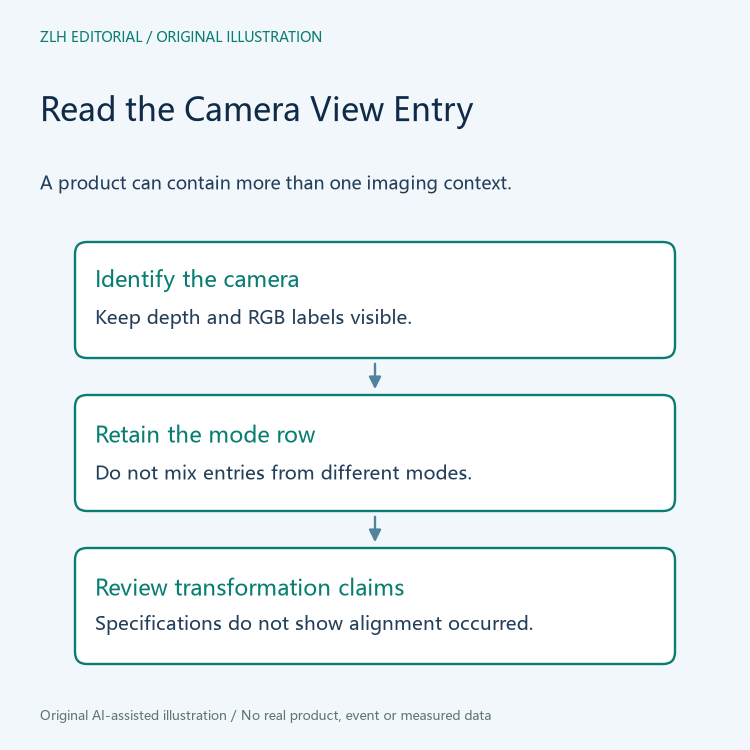
Keep the operating-mode row with its explanation
The manufacturer's Femto Bolt Hardware Specifications separates depth operating modes from colour operating modes. Its colour table includes image resolution, aspect ratio and nominal field of view, while its depth section describes several modes. This table context matters when a contributor extracts one entry for an equipment record.
The review can ask which row was copied and which qualifications belong to it. Do not take a mode-dependent property from one row and combine it with a different row's resolution to create a new undocumented combination. This article repeats no numerical settings and makes no assertion that any particular mode has been enabled. It explains how a source row remains identifiable after information moves into a handover table.
Do not infer aligned images from two specification entries
A document that describes both camera views does not by itself show that submitted images have been transformed into a common representation. If an appendix claims alignment, ask the contributor to identify the transformation account and its inputs. The presence of depth and colour fields in one product table is insufficient evidence that an actual transformation has occurred.
Likewise, a camera screenshot does not automatically identify the mode used to create it. The contributor should explain the relationship between the image, the product configuration and the specification entry being discussed. Where that relationship is missing, keep an explicit question. Do not infer coverage, registration accuracy or scene dimensions from an attractive example image and an unrelated specification row.
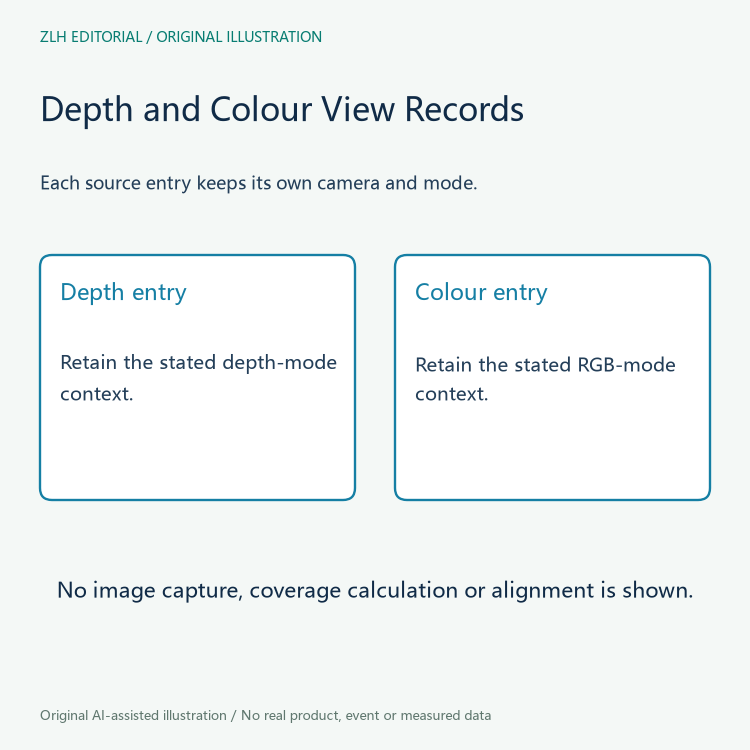
Review a fictional vision-sensor appendix
Imagine a fictional robot-learning station called Vision Linden. Its appendix lists one field of view beside a colour-image caption, but the cited source entry belongs to a depth mode. Another line claims that the views are already aligned, without identifying any transformation or sample source. The documentary issue is that the appendix mixes the scope of its claims. It is not a measured finding about the camera.
A useful correction would identify the camera type and mode associated with each specification statement. The alignment claim needs its own supporting account or an explicit unresolved status. The reviewer should not manufacture an image pair or choose a numerical calibration example to fill the gap. A clear description of what the contributor supplied is more useful than a polished appendix built from unsupported assumptions.
When revised material arrives, keep its source context visible. If the contributor changes the operating mode, that is a changed input rather than merely a new caption. If only a field label was corrected, describe that limited change. If an actual transformation report is later provided, identify it as additional evidence with its own declared inputs. These distinctions help another reader understand why a particular statement can now be made.
Keep the review conclusion tied to the supplied record
A bounded conclusion can state that depth and colour view entries now retain their camera and mode context, with any transformation question listed separately. It should not state that a robot's perception coverage, calibration or image quality has been validated. None of those observations has been performed in this fictional document exercise.
The site's reference category and related-information category provide further navigation. If later documentation changes a mode table or replaces an image, return to the particular entry and association affected. Retaining the camera, mode and source together makes the equipment record useful without overstating what a specification can establish.