

OpenCV 5 News: Keep Array Shape Beside Vision Values
2026-11-03
OpenCV 5 News: Keep Array Shape Beside Vision Values
A list of values from a vision application needs an explanation of its organization before another person can interpret it. OpenCV 5's migration material makes this issue concrete through a change in array shape. For equipment information readers, the news is useful because a software representation can change while a familiar-looking value list remains in view. The appropriate response is to ask how the output is structured and what each part is intended to mean.
Locate the array change in the OpenCV 5 material
The official OpenCV 5.0.0 release record was published June 6, 2026 and directs readers to the migration guide. This article revisits that release material as checked in November; it does not report a new November launch. The distinction keeps the date of the software development separate from the date on which an equipment reader consults it.
The official migration guide describes a vector-backed matrix that was represented as a two-dimensional column in 4.x becoming a true one-dimensional array in 5.x. This is a specific documented representation change. It is not a statement that a camera has changed its physical coordinate system or that the meaning of every application output has automatically changed.
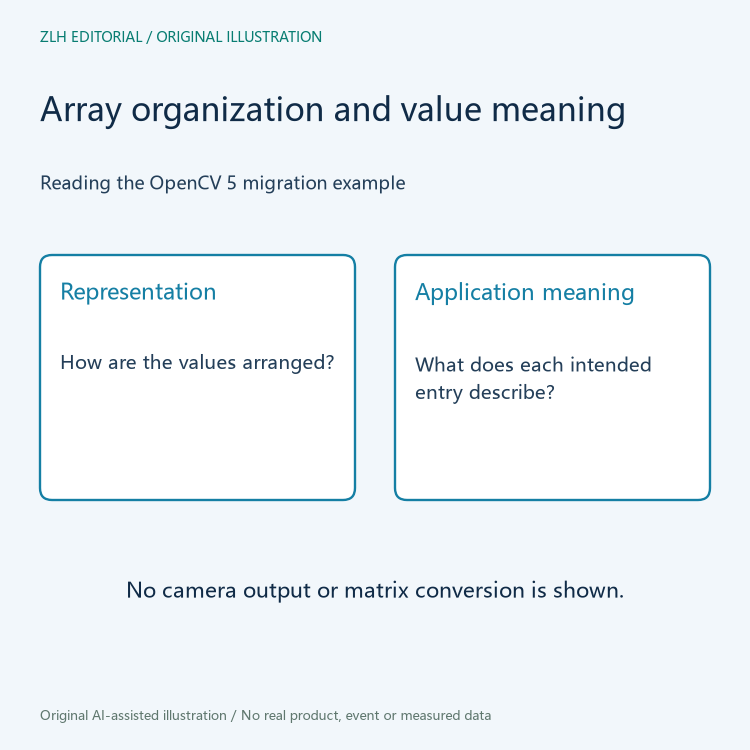
A familiar value list can leave its organization unexplained
Imagine a hypothetical equipment handover containing an output attachment and a short sentence saying that the numbers are vision results. The recipient still needs to know which parts of the output belong together. A flat list on a page may hide an underlying arrangement. Ask the author to identify the structure represented by the attachment and explain how the intended reader should locate the relevant values.
That explanation should remain connected to the actual output edition. If an application is revised, a previous screenshot may no longer describe its representation accurately. The author can identify what changed and what was preserved. This article does not inspect a delivered application, infer a coordinate convention from a picture or propose an adjustment to equipment software.
Shape information also has a different role from the meaning assigned to a value. Knowing that an array has one dimension does not tell the reader whether an element is a coordinate, category or other result. The application documentation must provide that meaning. Retaining both descriptions avoids a situation in which everyone recognizes the file format but nobody can explain the particular entry being discussed.
Make a comparison identify the relevant representation
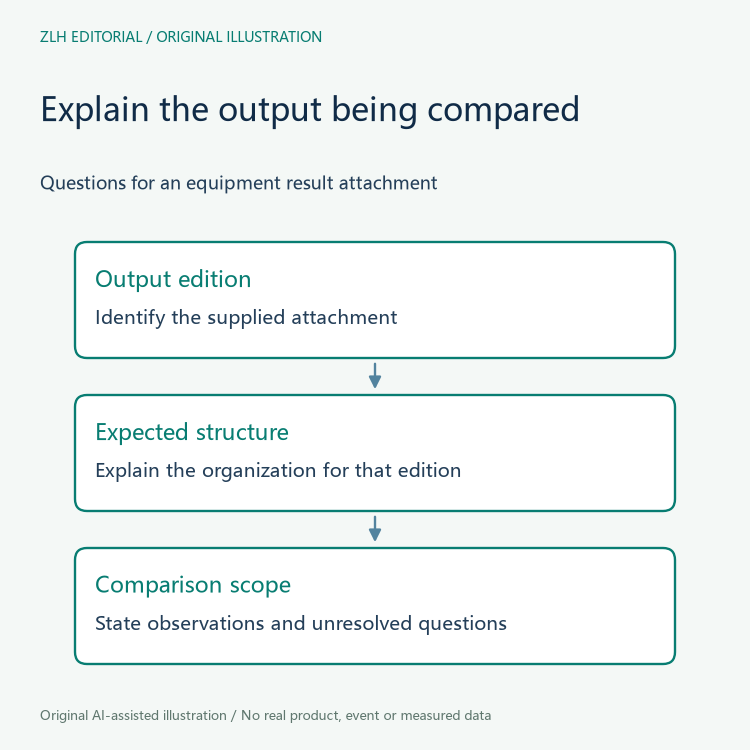
If a team later compares outputs from two software environments, it should identify the arrangement expected in each. The purpose is to understand the comparison, not to assume that a different shape proves incorrect equipment behavior. Values can be arranged or displayed differently for several reasons; the actual explanation needs evidence from the program and its author.
A clear comparison can state what was supplied, what was observed and what remains unresolved. If only exported text is available, note that limitation. Do not construct an internal array description solely because the upstream library documents a particular change. The application might use a different path or another version. The release provides a question to investigate rather than the answer for every program.
Keep presentation and application meaning connected
The person preparing an equipment report can help by including a concise description of the result organization near the relevant output. Readers should be able to find it without guessing from row breaks introduced by a document editor. If a rendering step changes the visible layout, the explanation should still point to the correct object and preserve the original source for authorized review.
This is not a request to duplicate every implementation detail in an operator interface. The necessary level of explanation depends on the question the document is meant to answer. A technical recipient comparing outputs may need a precise structure reference, while a general reader may need a clear description of the represented result. Both should receive statements that match the evidence actually available.
Use migration news to sharpen the handover question
The OpenCV example shows why array shape belongs beside values when their organization matters to interpretation. It does not justify a general claim about compatibility, detection accuracy or physical measurement. No camera, matrix operation or equipment test was run for this article. Any future evaluation would need its own identified inputs and observations.
The original diagrams map representation and meaning without showing actual vision data. Related topics appear in our equipment information collection and article directory. Preserve the version-specific source as background, then ask the application author to explain the actual output being handed over. That keeps a useful software development connected to an answerable equipment documentation question.


