

Equipment Records Practice: Preserve the Unit Expression
2026-11-02
Equipment Records Practice: Preserve the Unit Expression
A unit expression belongs with the quantity it helps describe. When equipment records move between a document and a data system, changing that expression for visual consistency can introduce an interpretation that nobody intended. This article proposes an offline review exercise using an imaginary equipment sheet. It contains no actual specification, conversion result, measurement, or acceptance threshold. The first task is to understand the supplied notation before deciding how another representation should be produced.
Keep the supplied expression beside its quantity description
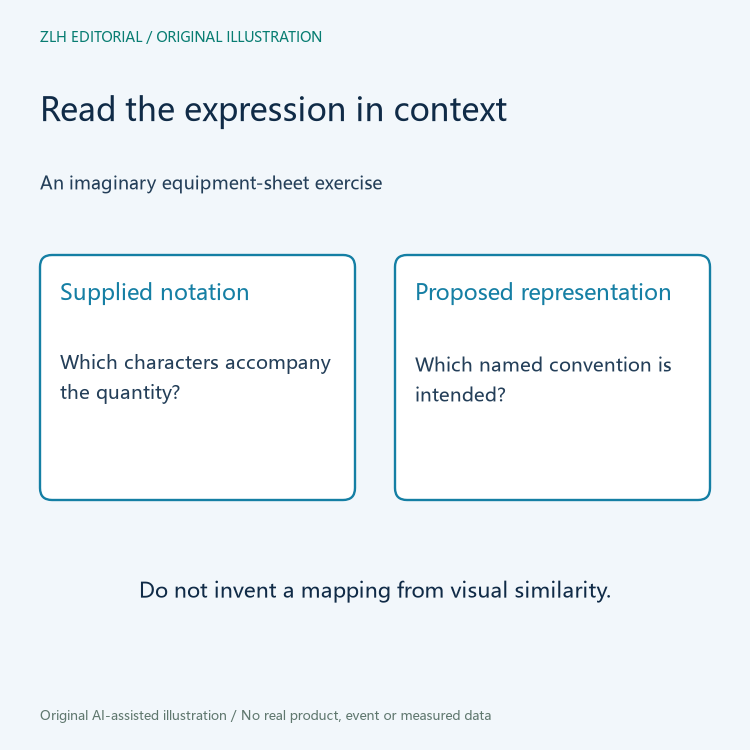
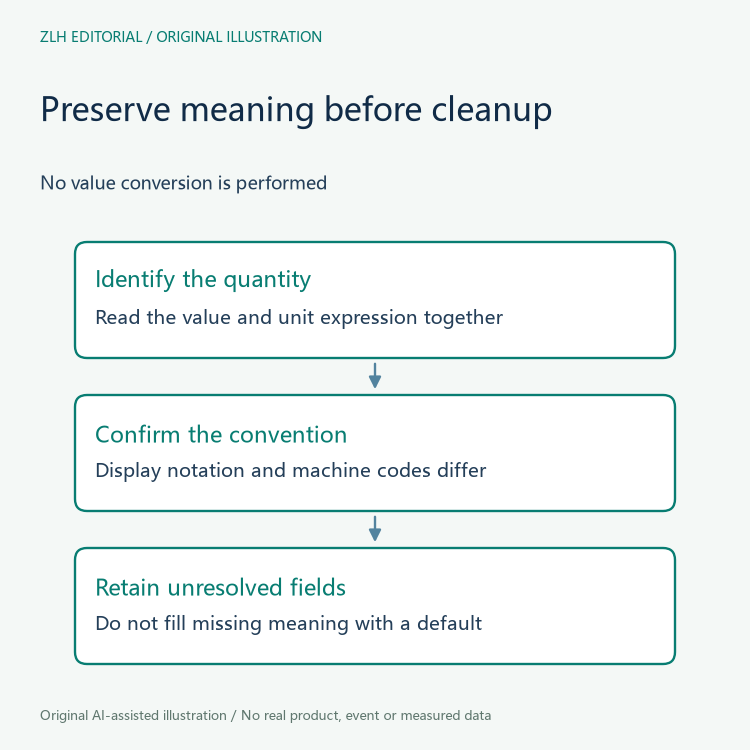
Start by identifying what the field is meant to describe. The learner should distinguish the quantity description, the supplied value, and the associated unit expression. These parts should be read together, while their different roles remain visible. A familiar-looking symbol does not remove the need to understand the field.
The NIST guide to expressing quantity values discusses numerical values together with units. It provides context for careful presentation. This exercise does not infer a real equipment parameter from the guide or replace the source document’s missing information with an example from it.
For the fictional sheet, retain the original expression before proposing any change. A learner should be able to point to what was supplied and explain which characters belong to it. The article gives no actual unit-value pair that could be mistaken for a product claim.
Separate visual editing from a change in meaning
An editor may want a document to look consistent. That is a presentation goal, while interpreting a unit is a meaning question. Before applying a global text change, ask whether the operation would affect the expression itself or only the surrounding prose.
This article recommends preserving the supplied characters until their role is understood. It does not propose automatically changing capitalization, replacing symbols with similar-looking text, or removing punctuation from every unit field. A broad cleanup rule should not decide an unresolved technical meaning.
If the expression is unclear, keep that uncertainty beside the field. The responsible source can explain what was intended. A complete-looking record built from guesses would make the later review harder, even if every row follows the same visual style.
Distinguish a machine code from a display convention
The UCUM specification describes a code system focused on electronic communication of quantities and units. A data exchange code and a human-facing display therefore deserve an explicit relationship. They should not be treated as interchangeable merely because both concern units.
In the imaginary exercise, the learner can ask whether a supplied field is intended as display notation or as a code under a named convention. If a destination requires a particular convention, the mapping should be explained by someone who understands it. The article does not invent such a mapping.
The existence of a code system also does not prove that an arbitrary source uses it. The fictional record should not acquire an assumed UCUM identity simply because an editor recognizes a short symbol. The actual source arrangement remains a question until it is established.
Review any proposed mapping on its own basis
If an instructor prepares a mapping exercise, use an authorized copy and keep the source expression visible. The learner should explain which convention is being applied, which destination representation is proposed, and what information supports that proposal. No conversion is executed by this article.
A successful text transfer would not establish that a measurement is accurate or a device meets a requirement. Those are further claims about the underlying quantity and its use. The mapping exercise concerns representation, so its conclusion should stay at that level.
If the source cannot be interpreted, stop the mapping for that field rather than selecting a convenient default. Other clearly understood fields can still be discussed independently. One unresolved expression should remain a specific question, not be hidden inside a general completion label.
Explain the result to a reader of the final record
A second learner should be able to distinguish the original notation from any proposed destination code. Ask them why each appears and what the exercise has actually established. If they infer a physical conversion or a verified product specification, the explanation needs a narrower statement.
Retain enough context for a future editor to continue the inquiry without reconstructing it from appearance alone. This is an editorial proposal for the fictional lesson, not a universal equipment-data standard or a declaration that a real record is suitable for procurement.
Related discussion appears in our equipment specification records section and the reading directory. The two original conceptual diagrams contain no numerical values, unit conversions, measured performance, or actual equipment record.


